Best SCA Tools 2026: Compare Top Solutions
Seven SCA tools compared for 2026 — Install Safe, Snyk, GitHub, Sonatype, Mend, JFrog and Black Duck — with a side-by-side table and a framework for choosing based on where you want risk stopped.
You're staring at another dependency update in package.json, and the question isn't whether it's safe, it's whether it becomes a supply-chain problem before lunch. That's why software composition analysis matters, but the key decision isn't just which scanner finds the most CVEs. The sharper choice is between shift-left scanning after install and shield-right blocking before a bad package ever reaches your developers, CI jobs, or AI coding agents.
The market reflects that pressure. One estimate puts the global SCA market at USD 394.14 million in 2025 and projects it to reach USD 1.68 billion by 2033 (Splunk's market overview). Another forecast pegs the market at USD 382.7 billion in 2025 and USD 1,657.11 billion by 2034, with North America holding the largest share in 2024 (Straits Research forecast). The exact sizing differs by model, but the signal is the same, SCA is no longer a niche add-on, it's part of the standard DevSecOps control set. For teams comparing the best SCA tools, the practical question is simple, do you want to detect risk after the install, or stop it at the registry edge?
Table of Contents
- 1. InstallSafe
- 2. Snyk Open Source
- 3. GitHub Advanced Security with Dependabot
- 4. Sonatype Platform, Nexus Lifecycle and Repository Firewall
- 5. Mend SCA with Renovate
- 6. JFrog Xray
- 7. Synopsys Black Duck Including Polaris SaaS
- Top 7 SCA Tools, Side-by-Side Comparison
- How to Choose the Right SCA Tool for Your Team
1. InstallSafe
InstallSafe stands out because it doesn't wait for your team to install a bad package and then complain about it later. It acts as a drop-in npm registry proxy, filters package metadata in real time against OSV.dev advisories, and prevents vulnerable or malicious versions from ever becoming visible to protected clients. That makes it a true shield-right control, not just another post-install scanner. The August 2026 keyv worm is the case study for why that distinction matters: it stole credentials during the install lifecycle script, before any scanner had something to report.
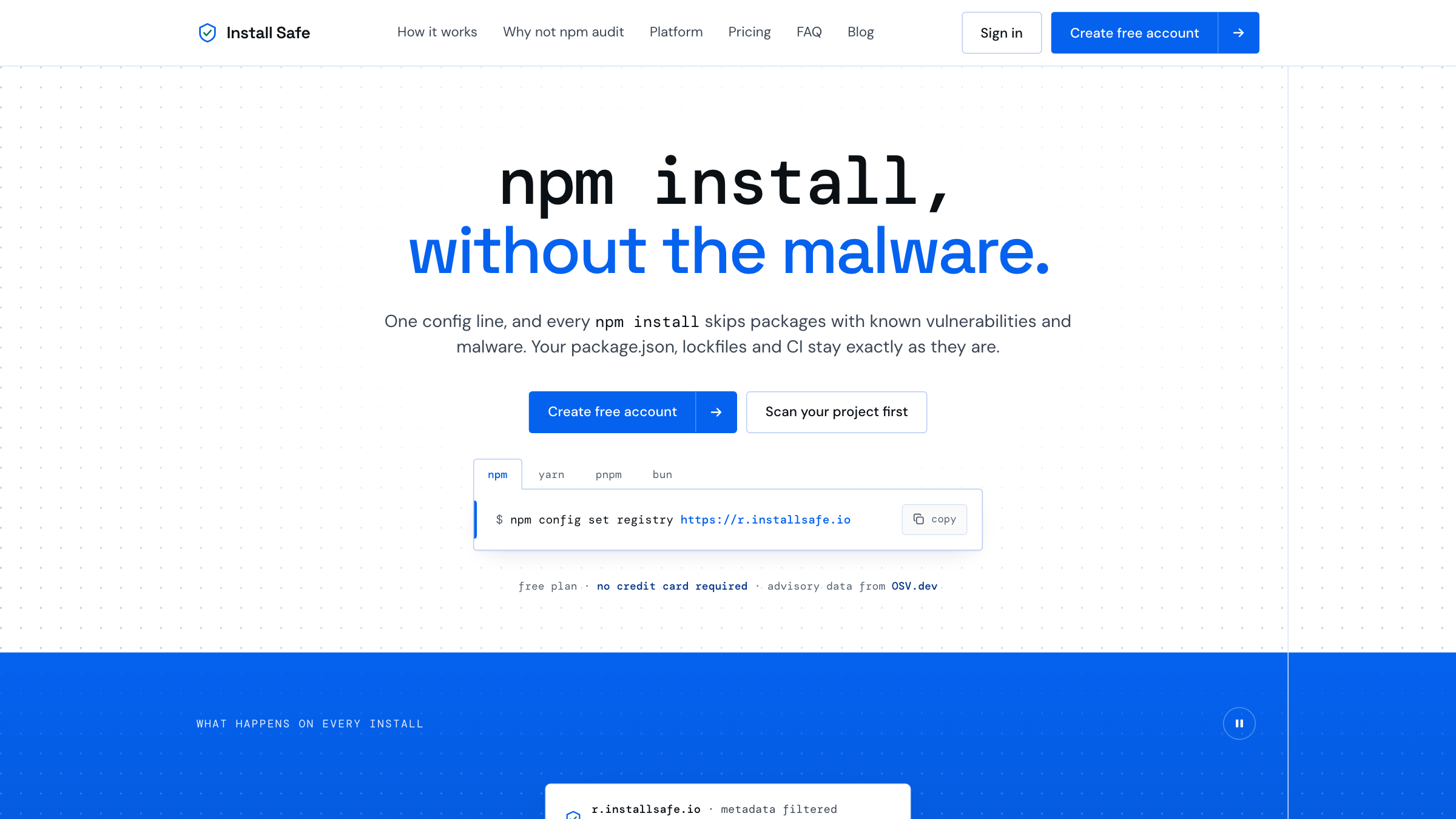
Because it works at the registry layer, a compromised or typosquatted version doesn't exist for the developer, the CI pipeline, or an AI agent that tries to resolve it. It supports npm, yarn, pnpm, bun, and CI tools like Renovate through a single registry URL or .npmrc setting, which is the kind of low-friction rollout organizations need. It also preserves existing workflows, lockfiles, and tarball integrity, which matters if you don't want security policy to break the build for unrelated reasons.
Practical rule: If your biggest concern is a malicious package showing up during install, registry-layer blocking is stronger than after-the-fact alerting.
The controls are unusually practical. InstallSafe offers severity-based policies, a release quarantine for versions younger than a chosen number of days, and allow/deny rules per package and semver range. It also adds per-machine and per-pipeline hashed, revocable tokens, centralized team policy, Slack alerts, a live activity dashboard, and a full audit trail with advisory IDs for each blocked resolution. That combination makes it useful for individual developers, platform teams, and orgs running AI coding agents that can accidentally pull in nonsense or hijacked namespaces.
The trade-offs are real. The Free plan covers proxy installs, live filtering of Critical and High advisories and a 7-day activity log with no card required; Pro is $9/month for configurable thresholds, quarantine rules and a 90-day audit log, and Team is $15 per seat/month for org-wide policy and Slack alerts. InstallSafe also depends on advisory feeds, so if data is missing or delayed, some threats may slip through until the feed catches up. Still, it's the cleanest option here for teams that want proactive blocking instead of just better alerts. For a closer look at how it scans and filters dependency traffic, see InstallSafe's scan flow.
2. Snyk Open Source
A team usually reaches for Snyk Open Source when developer adoption matters as much as detection. It plugs into Git, CI, and IDE workflows, so engineers see dependency issues where they already work instead of in another console. That practical fit is why it keeps coming up in discussions of the best SCA tools for npm-heavy and fast-moving teams. If you are weighing it specifically against install-time blocking, our Snyk alternative comparison covers that trade-off in detail.
Snyk OSS is strongest in remediation. Automated fix pull requests cut down manual triage, and its policy and reporting features let security teams govern updates without turning every dependency issue into a ticket queue. It also covers common JavaScript ecosystems, including npm, Yarn, and pnpm, so it stays relevant for teams working across JavaScript and TypeScript stacks.
Snyk works best when your team wants security to feel native to the developer loop, not bolted on after code review.
The trade-offs show up in packaging and scale. Snyk's broader platform splits OSS, SAST, container, and IaC into separate products, so teams need to check what is included and what costs extra. That becomes more noticeable as usage grows, because plan limits and consumption caps can turn into operational overhead. For teams that want a fast on-ramp and Git-centric workflows, Snyk is a practical choice. For teams focused on stopping bad installs before they happen, it still sits in the shift-left camp, with alerts and remediation after the dependency is already in play rather than registry-level blocking.
For teams already using developer-side scanning and wanting a post-install workflow comparison, the scan page from InstallSafe is a useful contrast point.
3. GitHub Advanced Security with Dependabot
GitHub Advanced Security makes sense when your entire codebase already lives in GitHub and you want the lowest possible adoption friction. Dependabot alerts, automated updates, dependency review in pull requests, and organization-level APIs are all built around that environment, so the experience feels native instead of layered on top. That's why many GitHub-centric teams consider it one of the best SCA tools for day-to-day dependency hygiene.
The upside is obvious. Setup is light, the pull request automation is familiar to developers, and org-wide visibility is easy to centralize through GitHub APIs. For a team that already standardizes on GitHub for source control, that native fit can matter more than a long feature checklist.
The limit is just as clear. GHAS is best for repositories hosted on GitHub, so cross-platform workflows are constrained. It's also a classic shift-left model, it warns and updates after the dependency is already in play, which is valuable but not the same as blocking a bad package from entering the pipeline in the first place. If your supply-chain concern includes typosquatting, malicious releases, or agent-driven installs, you'll still want a stronger gate somewhere closer to resolution.
There's a broader adoption signal behind GitHub's model too. A 2026 review cited 846K+ repos, 137% year-over-year growth, and said GitHub is used by 25% of the Fortune 100 in that source's summary (Pixee's 2026 review). That doesn't make GHAS automatically the right choice, but it does explain why GitHub-native dependency scanning keeps winning internal budget fights.
4. Sonatype Platform, Nexus Lifecycle and Repository Firewall
Sonatype is one of the few vendors that makes the shift-left versus shield-right distinction feel like a product strategy, not a marketing slogan. Nexus Lifecycle handles the analysis and policy side, while Repository Firewall adds the pre-fetch control that can block malicious or vulnerable components before developers ever download them. For organizations that want governance at the artifact layer, that combination is hard to ignore.
The value here is architectural. Lifecycle gives you the traditional SCA view, while Repository Firewall turns the repository into an enforcement point. That means you can centralize control over npm, Maven, PyPI, and NuGet flows instead of relying only on developer-side warnings. It's a good fit for teams that treat the repository as a policy boundary.
If your supply chain is already centralized through an artifact manager, blocking at that layer usually beats trying to coach every developer into perfect hygiene.
The downside is complexity. Sonatype is sales-led, so pricing isn't public, and the platform can feel heavier than a developer-first scanner. It's also most compelling when you're already invested in the Sonatype ecosystem, which narrows its appeal for teams that want a lighter touch. Still, if your security program needs both post-install visibility and pre-install blocking, Sonatype belongs near the top of the shortlist. For teams thinking in those terms, the InstallSafe homepage is worth comparing against a heavier repository-first stack.
5. Mend SCA with Renovate
Mend is strongest when the pain isn't finding dependency issues, it's getting fixes merged without breaking the build. Its SCA workflow pairs well with Renovate, which means automated update pull requests can be grouped, tested, and pushed through with less manual effort. That makes it a practical choice for teams that already live in a steady stream of dependency maintenance.
The platform is especially useful when governance matters across many projects. It offers compliance and reporting features, policy controls, and remediation guidance that helps teams decide what to fix first. The workflow feels enterprise-oriented, which is good if you need consistency across multiple repos and business units.
The trade-off is transparency. Public pricing isn't published, and feature entitlements can be harder to compare than they should be. That makes procurement slower, and it can complicate evaluation if you're trying to map exactly what comes with each plan. Even so, Mend remains attractive for engineering orgs that want automation plus governance, especially when the team is already comfortable with Renovate-driven update workflows.
Where Mend fits best
- Dependency-heavy platforms where update volume is high and manual review is a bottleneck.
- Compliance-focused organizations that need policy reporting and centralized oversight.
- Teams that trust automated updates more than manual patching cycles.
6. JFrog Xray
JFrog Xray makes the most sense when the artifact repository is already the center of gravity. If your team stores packages, binaries, and containers in Artifactory, Xray gives you policy-driven security checks where those assets already live. That is a different posture from a scanner that only gets involved after code is checked out and a build is already in motion.
The appeal is control. Xray can scan builds and repositories recursively, apply policy gates, and block downloads or releases based on those policies. For teams that want one platform for package, container, and supply-chain security workflows, that centralization can reduce tool sprawl and make enforcement easier to explain.
The trade-off is packaging and operational weight. Capabilities vary by subscription tier, so you need to review what is included before you assume a feature is available. JFrog is rarely the cheapest or lightest option, and it fits better as part of a broader artifact governance strategy than as a small-team dependency checker. If Artifactory is already your source of truth, Xray feels like a natural extension of the platform rather than an extra layer of friction.
Use JFrog Xray when you want policy enforcement close to storage and distribution, not just visibility after the fact.
For teams comparing registry-level controls, the central question is whether you want a broad artifact platform or a focused package proxy. Xray suits the former. A narrower tool suits the latter when the goal is fast package-layer blocking without taking on a larger governance stack.
7. Synopsys Black Duck Including Polaris SaaS
Black Duck remains relevant for a specific kind of environment, the one with legacy code, mixed languages, and source that doesn't always map neatly to package manifests. Its file system, snippet, and build monitoring modes help surface components that a simple dependency scanner can miss. That's why it still belongs in the discussion around the best SCA tools for enterprise governance.
The strength is discovery depth. Black Duck is built to find open source usage even when the package manager doesn't tell the full story, which is valuable in older estates and regulated environments. The Polaris SaaS option also gives larger programs a way to unify AppSec analytics across SAST, SCA, and DAST.
The cost is operational weight. Deployments tend to be heavier than developer-first tools, and pricing is sales-led, so you'll be working through demos and quotes instead of quick checkout pages. That's not a flaw if your organization needs governance, reporting, and deep component discovery. It is a mismatch if your team wants a lightweight control that developers can adopt in an afternoon.
Black Duck is best read as an enterprise governance platform first, and a dependency hygiene tool second. For newer JavaScript and TypeScript teams, it's often more than they need. For mixed-language estates with audit pressure, it still has a real place. If your priority is a simpler registry-layer defense for modern package workflows, InstallSafe's blog can help you compare that model against broader enterprise tooling.
Top 7 SCA Tools, Side-by-Side Comparison
| Tool | Implementation Complexity | Resource Requirements | 1/5 · Expected Outcomes | Ideal Use Cases | Key Advantages |
|---|---|---|---|---|---|
| InstallSafe | Low, drop-in registry proxy, minimal workflow change | Low infra; paid SaaS ($9 Pro / $15 seat Team) | 5/5 · Prevents exposure/installs of vulnerable/malicious versions | npm-heavy teams, CI pipelines, AI coding agents | Blocks compromised packages before install; preserves lockfiles & tarballs; live OSV advisory resolution; team tokens & audit trail |
| Snyk Open Source (OSS) | Moderate, repo/CI/IDE integrations and policy setup | Medium, SaaS seats, CI/IDE integration; plan limits possible | 4/5 · Finds & prioritizes vulnerabilities; automated remediation PRs | Developer-centric projects, fast on-ramp for JS/TS stacks | Strong dev workflow integration; automated PR fixes; license reporting |
| GitHub Advanced Security (GHAS) + Dependabot | Low (native to GitHub); higher cross-platform effort | Medium, billed per active committer; GitHub-hosted repos preferred | 4/5 · Automated alerts & updates; repo-level dependency review | Organizations hosted on GitHub seeking native SCA | Native integration; Dependabot automated updates; org-level policies & APIs |
| Sonatype Platform (Nexus Lifecycle + Firewall) | High, enterprise deployment, policy enforcement across pipelines | High, repository/proxy infrastructure; sales-led pricing | 4/5 · Proactive blocking at registry edge; comprehensive governance | Organizations centralizing artifact control across languages | Combines shift-left lifecycle with repository firewall; long-standing vuln intelligence |
| Mend SCA + Renovate | Moderate, SCA plus Renovate automation and policy tuning | Medium–High, enterprise licensing; Renovate automation | 3/5 · Improved remediation throughput; higher upgrade success rates | Enterprises wanting automated, safer dependency updates | Strong Renovate automation for grouped updates; reachability-aware prioritization |
| JFrog Xray | High, deep Artifactory integration and policy configuration | High, platform licensing, tiered features and storage | 4/5 · Policy-driven gates; block downloads/releases; broad coverage | Teams standardizing on Artifactory for artifacts and containers | Recursive build scans; policy gates across repos; single platform for binaries & containers |
| Synopsys Black Duck (Polaris) | High, multiple discovery modes and heavier deployments | High, sales-led pricing; on-prem/cloud options | 4/5 · Comprehensive component discovery including undeclared OSS | Large enterprises, legacy/multi-language codebases | Deep file/snippet discovery; broad license & governance reporting; enterprise analytics |
How to Choose the Right SCA Tool for Your Team
The best SCA tool depends on where you want control to happen. If you want to catch problems after they land in the repo, developer-first tools like Snyk, GitHub Advanced Security, and Mend give you familiar PR-based workflows and remediation automation. If you want to prevent bad packages from ever entering the environment, InstallSafe, Sonatype Repository Firewall, and JFrog Xray move the control point closer to the registry or artifact layer. Behavioural scanners such as Socket.dev occupy a third position, flagging suspicious package behaviour before any advisory exists — our Socket.dev alternative comparison maps where that overlaps with registry-level blocking.
That shift matters more than the product label. Shift-left tools are great for visibility, governance, and remediation once a dependency exists in the workflow. Shield-right tools are better when you care about live blocking, typosquatting, malicious releases, or AI-assisted installs that can pull in the wrong thing before anyone notices.
Reachability also deserves more weight than most vendor pages give it. A 2026 evaluation guide emphasizes that the modern benchmark is not raw alert volume, it's whether a tool can reduce noise with reachability analysis, good remediation, and CI/CD fit (Endor Labs comparison guide). The same guide notes there's no universal best SCA tool, which is exactly right, the right answer depends on whether you're optimizing for low-noise detection, policy enforcement, or developer speed. If you're already drowning in false positives or worried about malicious package exposure, don't start by asking which scanner has the longest feature list. Start by asking where you want the package to be stopped.
If you want a registry-layer defense that blocks vulnerable and malicious npm packages before they ever reach your developers or CI pipelines, InstallSafe is built for that job. It gives you live policy control, clean installs, and auditability without forcing a workflow rewrite. Visit InstallSafe to see how it fits the shift-right side of your software supply chain strategy.
If your stack is JavaScript-first, the same comparison narrowed to the npm ecosystem is in our npm vulnerability scanner comparison.